Desierto Books
Sanctus Sonorensis / Philip Zimmerman
Sanctus Sonorensis / Philip Zimmerman
Couldn't load pickup availability
Philips Zimmerman, 2009. Decorative board book. New.
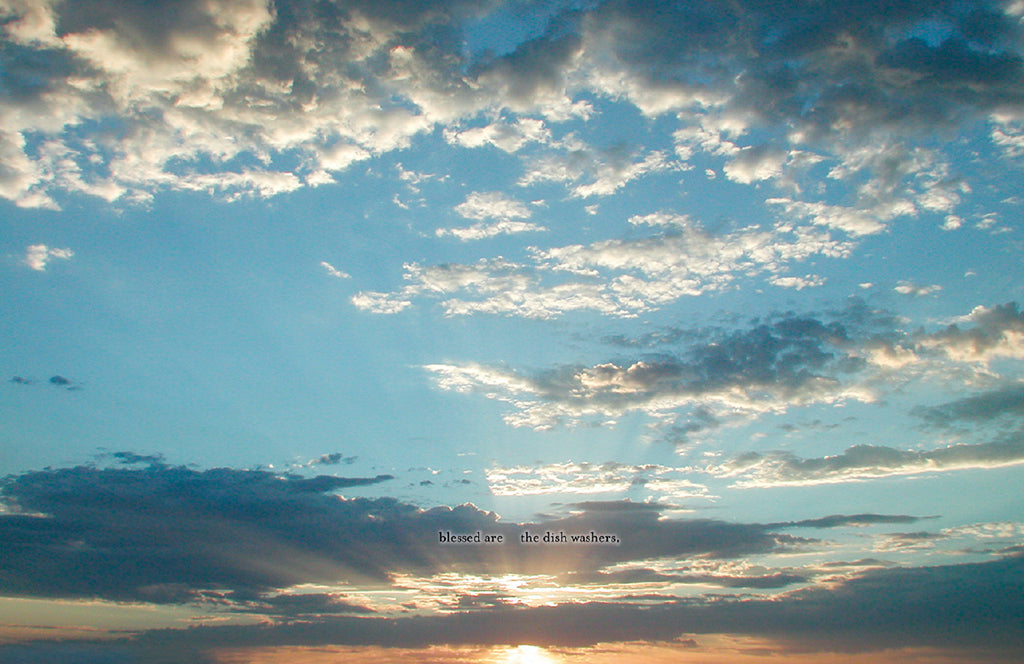
Sanctus Sonorensis is a book of border ‘beatitudes’. This work comments on the complicated attitudes of Americans on illegal immigration from Mexico. The cover shows a photograph of the area of Southern Arizona which is the most active in terms of migration across the Sonoran desert, and where thousands have lost their lives in the deadly desert heat. The interior pages show the progression of a typical high-desert day from dawn to sunset, mimicking the sky above an immigrant during a day’s desert passage, and accompanied by a single line of text on each two-page spread.
I had the germ of an idea for the book, and did some little preliminary sketches for it, during my sabbatical in 2003-2004. I was in a year-long residency at the Border Art Residency in La Union, New Mexico. I was taking a lot of photos of the incredible skies in New Mexico and Arizona while there, and they made their way into a lot of the work that I made during my year there. Living right on the border I was also very aware of the crossing of illegal Mexican immigrants, especially in a section of the Sonoran desert near Why and Ajo Arizona which I visited several times. In December of 2004, I was driving back into the United States from Mexico through the Lukeville border crossing. As I was travelling through the Organ Pipe Cactus National Monument just inside Arizona, I was stopped for a couple of hours by several groups of uniformed men. Each group consisted of a large number of heavily armed Border Patrol agents on some sort of special operations. The agents eventually led out of the desert scrub a large number of illegal immigrants who had been hiding in the mesquite and cactus as they attempted to head north through the park. They clearly weren’t drug smugglers. They looked too poor and were unarmed. They made for a rather moving and pathetic sight and looked dishevelled and dejected. I had never seen an operation like this up close and it was rather upsetting, and got me thinking about the life these people were trying to make for themselves and the efforts that we in the United States make to prevent them from coming here. Sanctus Sonorensis was a work that eventually came out of this experience.
The starkness of our immigration law in regard to undocumented workers was made evident again when I almost got my camera confiscated by the Border Patrol while I was taking photos of several busloads of undocumented Mexican workers being transported by agents back across the border into Mexico in Agua Prieta. The disparity between the unhappy apprehended Mexicans being returned back across the border and the reality of the fact that there are 460,000 undocumented Mexican workers in Arizona alone, seemed glaring. Most of them pay taxes while they are here and usually fill unpleasant and difficult jobs that most Americans will not take.
During the summer of 2006, I did a one-month residency at Light Work at Syracuse University in New York State, and while there I completed two books that I had started work on earlier, Shelter and a finished inkjet version of Sanctus Sonorensis. Like some other books I have done, I planned on having two different editions, one inkjet and the other either offset or HP Indigo. After I printed about 5 or 6 copies of Sanctus on my Epson printer I realized that it was not feasible. Each book took almost $50 of archival pigmented inkjet ink and paper and had the familiar inkjet problem of fragile, easily scuffed, pages.
I was determined to raise the money to have it printed offset, which is my preferred printing medium. I had pitched the idea to Light Work since they occasionally print a monograph of one of the artists’ that do a residency there. However, it was a bit too large a book project for them to take on. After my move out here to teach at the University of Arizona in 2008, I tried getting a couple of grants to help with production costs, including one from the Arizona Council on the Arts. Unlike New York’s NYFA though, I found out that they do not give money to help with publication printing costs, not realizing that for artists’ bookmakers, this is like getting money for paints or film or whatever.
I decided to fund the project myself, though it was a real financial stretch. I knew that I wanted it to be a board book, a form that has no conventional sewn gutter since the spreads are printed as one sheet, using the paper as the folding hinge. This is terrific for images that cross the pages like the sky-scapes I used. It seemed like the perfect solution would have been to have it printed in either the United States or Mexico in print shops that had Mexican employees. However, only printers in Asia had the experience to make a board book of this size. My sales rep, Frances Harkness, at C&C Offset Printing in New York (an “off-shore” Chinese printing company with a branch in NYC) had been a student of mine many years ago at Purchase College, SUNY. She knows artists’ books and, like many artists’ book-makers, I like to push the physical structures of the book form, and she helped with some suggestions as far as production. C&C is probably one of the most experienced board-book printers in the world, a funny niche production area for printing. They printed over 100,000 copies of Art Spiegelman’s In the Shadow of No Towers, another large board book.
Share