Desierto Books
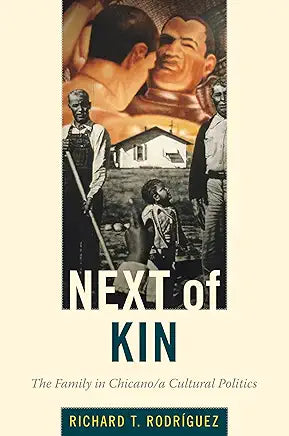
Next of Kin: The Family in Chicano/a Cultural Politics | by Richard T. Rodriguez and Richard T. Rodríguez
Next of Kin: The Family in Chicano/a Cultural Politics | by Richard T. Rodriguez and Richard T. Rodríguez
Couldn't load pickup availability
Duke University Press, 2009. Trade pb. Sunned spine, minor edge wear, and some highlighting of text. Good reader copy.
As both an idea and an institution, the family has been at the heart of Chicano/a cultural politics since the Mexican American civil rights movement emerged in the late 1960s. In Next of Kin, Richard T. Rodríguez explores the competing notions of la familia found in movement-inspired literature, film, video, music, painting, and other forms of cultural expression created by Chicano men. Drawing on cultural studies and feminist and queer theory, he examines representations of the family that reflect and support a patriarchal, heteronormative nationalism as well as those that reconfigure kinship to encompass alternative forms of belonging.
Describing how la familia came to be adopted as an organizing strategy for communitarian politics, Rodríguez looks at foundational texts including Rodolfo Gonzales’s well-known poem “I Am Joaquín,” the Chicano Liberation Youth Conference’s manifesto El Plan Espiritual de Aztlán, and José Armas’s La Familia de La Raza. Rodríguez analyzes representations of the family in the films I Am Joaquín, Yo Soy Chicano, and Chicana; the Los Angeles public affairs television series ¡Ahora!; the experimental videos of the artist-activist Harry Gamboa Jr.; and the work of hip-hop artists such as Kid Frost and Chicano Brotherhood. He reflects on homophobia in Chicano nationalist thought, and examines how Chicano gay men have responded to it in works including Al Lujan’s video S&M in the Hood, the paintings of Eugene Rodríguez, and a poem by the late activist Rodrigo Reyes. Next of Kin is both a wide-ranging assessment of la familia’s symbolic power and a hopeful call for a more inclusive cultural politics.
Share